
Sources for Previous Residents at a Patterson Address
A house history needs both title evidence and household evidence. Deeds identify parties to a recorded transfer. Assessment history can identify a current owner and document reference. Census schedules and directories can show a household at a dated address. Permits can date physical changes. Newspapers, obituaries, probate, and cemetery files can close or extend a family trail.
| Source | Local years | Where held | What it shows |
|---|---|---|---|
| Recorder index | 1850 to present | RecorderWorks and Clerk-Recorder | Parties, type, date, book-page or document number |
| Deed books and images | 1850 to present, availability varies | Recorder cart and office | Legal description, vesting, signatures, recorded terms |
| Assessor roll and history | Current roll; historical depth varies | Assessor kiosk and data channels | Owner, situs, mailing, current document, transfer fields |
| Recorded maps | Collection-specific | County GIS and Recorder | Subdivision, lot, block, parcel evolution |
| Federal census | 1790 to 1950 public | NARA, FamilySearch, library | Named household at an enumeration address |
| City directories | Exact Patterson run not verified | Library, Historical Society, State Library | Annual or intermittent name and address clue |
| Permits and planning | Project-dependent | Patterson Community Development | Construction, applicant, contractor, alterations, inspections |
| Obituaries and probate | Title or case-dependent | Library, Historical Society, Superior Court | Relatives, estate property, death or move endpoint |
Start with the source that matches the era. For a present parcel, begin with APN and owner. For a nineteenth-century question, RecorderWorks and deed books are stronger than a modern street label. For a household question, pair a directory or census with a deed instead of calling a title holder the only resident.
Begin With Today’s Patterson APN
Use the Stanislaus County GIS Hub to verify the address and parcel. Search by address, APN, or map point, click the parcel, and copy the APN, legal subdivision, lot, and map reference. Then use free Assessor Public Inquiry or inspect fuller public-roll information at the Modesto self-service station at 1010 10th Street, Suite 2400. The public web route expects the APN, which is why a map-first start is important.
Compare situs and mailing without merging them. Situs is the land location. Mailing is the notice destination. A different mailing address can reflect another residence, business, post-office box, or manager. The Assessor’s current document field may point to the instrument that begins the backward trail.
The Assessor access page explains that owner-name and situs searching is available through fuller kiosk or restricted Agency Inquiry routes, not as an unrestricted free reverse-address web search. This is an important local access quirk for previous residents.
Tracing Past Owners Through Stanislaus Deeds
RecorderWorks does not offer a button labeled previous residents. It offers the parties and identifiers from which an address history can be reconstructed. The chain starts with today’s owner or current document, then moves from grantee to the prior grantor.
- Open the current APN or Assessor document reference and search the owner in RecorderWorks.
- Find the acquisition grant deed and copy the grantor, grantee, recording date, document number or book and page, and legal description.
- Search the seller as an earlier grantee during a date window before the current transfer.
- Repeat the chain, comparing the legal description or APN at every step and separating deeds from liens or financing instruments.
- When an early result has no image, use the Clerk-Recorder counter, deed books, index books, microfilm, or the official copy-request form.
- Grantor
- The person or entity transferring an interest in a recorded instrument.
- Grantee
- The person or entity receiving the interest named in that instrument.
- Chain of title
- A sequence of recorded transfers connecting one holder to an earlier holder.
- Legal description
- Land-identifying language that can remain useful when a street name changes.
Grant deeds transfer title. Deeds of trust generally evidence a loan or refinance and should not be counted as a change of household. A will is filed in Probate Court, not recorded by the Recorder simply because real property is mentioned.
Grant Deed Versus Deed of Trust
Older Patterson records can place several names beside the same parcel. A grant deed is the transfer clue. A deed of trust points to a loan, beneficiary, trustee, or refinance. A lien or release can show a debt or its resolution. A map can show the land layout. Read the document type before treating a name as a previous owner.
RecorderWorks displays indexed document type, recording date, number or book-page, and party links. The cart offers Regular or Certified copies. A copy is useful when the index does not show the legal description, vesting language, signatures, or exact party role. The official-record request form asks for document title, date, number, volume, page, number of pages, copies, and certification.
Use the current fee page before sending payment. Research lists an official-record copy at $6.75 for the first page, $3 for each additional page, and $2 for certification, while the older form may display older figures. A search charge may also apply. Quote the current county schedule rather than an old PDF when planning a request.
Bridge Patterson’s 1980 Identifier Change
RecorderWorks spans 1850 to the present, but the identifier practice changes in 1980. Pre-1980 instruments use book and page. Instruments from 1980 forward use annual document numbers. Recorded maps keep book and page. Preserve the exact form in your notes and search the appropriate tab.
The online barrier is not a modern cutoff. It is variation in early indexing, image quality, and whether a document is available through the web cart. If a 1910s or 1920s result lacks an image, ask the Clerk-Recorder how to use index books, deed books, or microfilm. Keep the map reference beside the instrument number when the parcel evolved through a subdivision.
This identifier quirk is one reason previous residents should be traced from the parcel and legal description rather than from a modern address alone.
Use Legal Description When the Address Fails
Street labels can change, abbreviations can vary, and a postal city can cross the incorporated line. Patterson’s downtown radial plan adds another complication: Highway 33 is also Second Street. Search route and street forms, directional prefixes, APN, legal lot or block, and recorded map references whenever an address search fails.
The County GIS map and recorded-map layers can show subdivision, parcel-map, record-of-survey, corner-record, or certificate-of-correction material. A map may expose volume and page, city, and a linked PDF. Use the legal description from a deed to test whether the older record concerns the same land.
The official recorded-map guide is a helpful route when a street search gives no clean match. It explains the map categories without claiming that a particular Patterson parcel has a digitized map.
Past Patterson Households in Directories and Census
Ownership is only half of a previous-resident trail. A federal census can show a named household at an enumeration address through 1950. A city or telephone directory can offer an annual name and address clue when that volume exists. Patterson High yearbooks can add a cohort, and local notices can connect a person to relatives or a move. These are different kinds of evidence and should be labeled separately.
The exact Patterson city-directory run is not verified. Library holdings date to at least 1914 systemwide, NARA lists Modesto and Stanislaus County volumes for 1928 through 1933, and Polk’s 1950 Modesto volume is cataloged. The Patterson city directory collections page explains how to request the right shelf and pair years without inventing a continuous run.
Use a directory immediately before or after a decennial census. The directory supplies an annual address or occupation clue. The census supplies household relationships. Search surname variants and spouse or widow notations, then verify the volume’s abbreviation key.
Patterson Yearbooks Fill Household Gaps
Digitized Patterson High yearbook pages can help reconnect a former classmate or test a surname spelling when a city directory year is missing. Headings include 1917, 1920 and 1921, 1923 through 1939, and 1940 through 2013, with individual gaps possible. A yearbook identifies a cohort and school-year context. It does not establish that a person remained at the old address.
Request or inspect the Historical Society’s yearbook pages with the class year and name. Pair a page with RecorderWorks, a later notice, or a census when building a time line. Do not infer a complete household from a single class page.
When a past resident’s life ends in Patterson records, the Historical Society’s obituary and cemetery files or a Superior Court probate case can provide a relationship or estate clue, subject to redaction and access limits.

The yearbook display shows how a cohort source can supply a dated name clue without being mistaken for a property or current-resident record.
Patterson Permits Date Changes to a Building
A permit file can date construction, additions, inspections, or a named applicant. Patterson planning material describes a proposed replacement for an antiquated permit database, so no complete historical public web search should be promised. Request the address and APN through Community Development or a CPRA route.
For a building-history question, retain the project name, address, APN, owner or agent, plan date, contractor, and inspection event. A permit can establish that a person was connected to a project on a date. It does not establish that the person lived there, owned the parcel throughout the project, or remained after completion.
The city’s NextRequest portal lets a requester search published requests or submit a new one. If the record is held by the Sheriff because it concerns Patterson Police Services, route the request to the operational custodian instead of assuming City Hall has it.
Probate, Obituaries, and the Trail’s End
Obituaries and probate can close a previous-resident trail or connect an address to heirs. The Historical Society indexes weddings, obituaries, cemetery material, and family histories. Stanislaus Superior Court handles probate estates and trusts at City Towers, 801 10th Street, fourth floor, in Modesto. Public petitions and orders may be redacted, sealed, or limited.
The State Controller’s unclaimed-property search can separate a common name using last name, first name, city, ZIP, or Property ID. A Patterson or 95363 result is a prior reported context, not a current address. The search and claim process is free, and a finder’s fee is not needed merely to locate a listing.
Use each endpoint for its own fact. A death notice may identify relatives. A probate file may identify heirs or estate property. An unclaimed-property result may supply a holder clue. None replaces the deed chain or proves that a person lived at the address for the whole period. The State Controller name search below is a narrowing aid, not an address record.
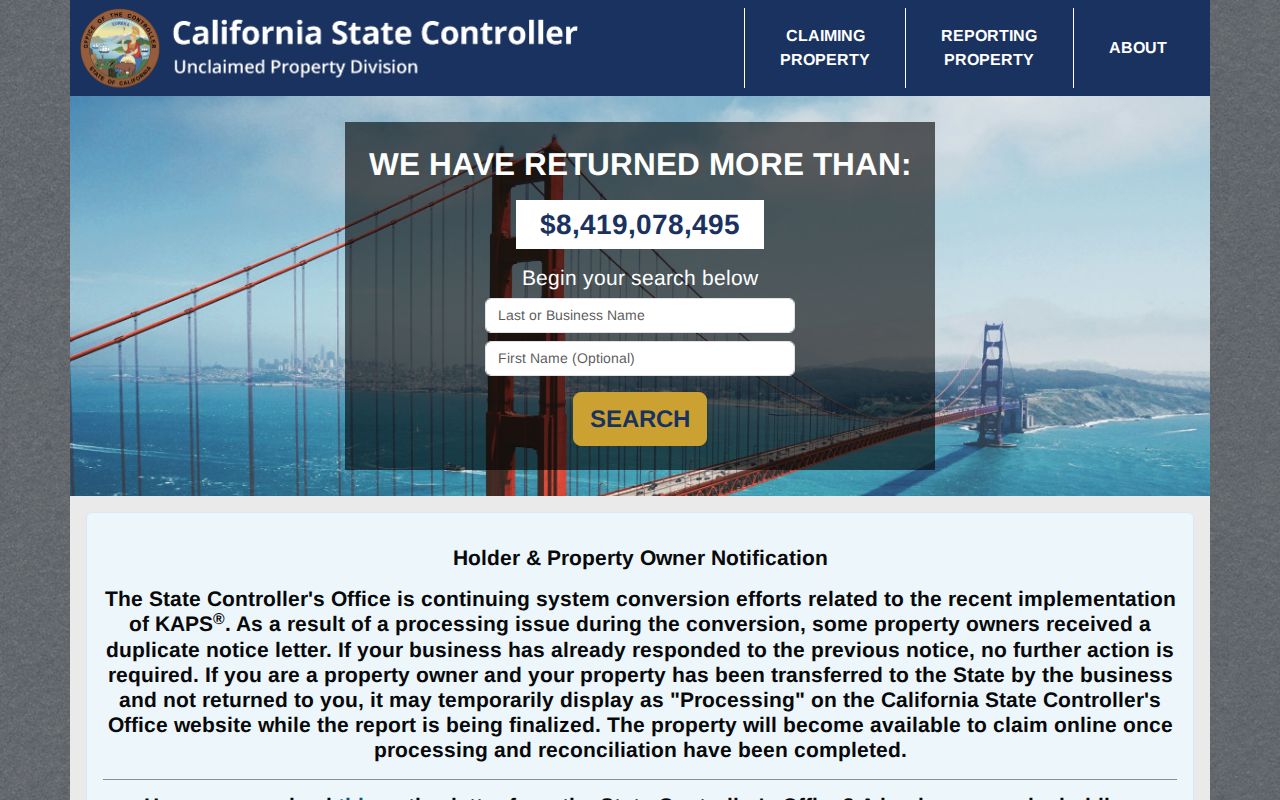
The State Controller screen illustrates a useful narrowing path for a historical name, while its limits keep the result from being overstated.
Highway 33, Second Street, and Patterson History
Address continuity in Patterson is shaped by local geography. The Colony map filed in 1909 created a radial town around Circle Plaza. Highway 33 is also Second Street. Newer named developments create different record eras than the older center. A literal search of one street string can therefore miss an older source.
Keep the route name, street name, directional form, APN, legal description, map volume and page, and deed identifier in one research note. Compare the map against the deed. If the land description fits but the street label differs, the difference may be an address alias rather than a different parcel.
Lawful Patterson House History
Previous residents research is suitable for a house history, family history, estate question, or personal curiosity. A title holder, directory entry, school page, obituary, or permit should be described with its date and source. The record cannot fill private household details that were never public.
Lawful use. Use past-resident records to understand a place or reconnect through appropriate channels. Do not use an address trail to stalk, harass, intimidate, or harm a living person.
California Penal Code section 646.9 addresses stalking. Safe at Home and protected voter classifications can shield addresses, while DMV and utility information remains outside an ordinary search. Stop when a record is protected or uncertain, and ask the original custodian about lawful access or correction.