
Find Context Around Patterson Neighbors
A block lookup is really a parcel-context exercise. Begin with one address, spot the polygons touching it, and hand each APN to the custodian that can describe that parcel. Patterson has no single shortcut. Keep the layers separate in a table and let each record answer one question.
| Source | What it shows about a block | Access |
|---|---|---|
| Parcel Inquiry Map | Adjoining geometry, APNs, land use, zoning, districts, flood and aerial context | Free map hub |
| Assessor roll | Assessed owners, situs, mailing, values, exemptions, characteristics | APN web basics; fuller kiosk |
| RecorderWorks | Recorded-document parties and chronology for each parcel | Free index; copies |
| Voter data | Registration information only for legally permitted use | Restricted; protected addresses suppressed |
| City planning and permits | Applicants and projects along the block | Address or APN request |
| Community groups | Public officers or contact points when published | No private member directory found |
Owners and occupants are different categories. An owner field or a mailing address can place a person inside a parcel record. A deed can do the same. It cannot list family members, visitors, or private association members. So any Patterson resident lookup should say plainly which layer produced each name.
Map a Patterson Block From One Address
The County GIS map is the supported starting point for adjoining parcels. Search the subject address or APN. Zoom until the lot lines read clearly, then click each neighboring polygon. Adjacent browsing is manual; the county offers no radius or buffer tool. Jot down the APNs before opening owner or document records.
- Confirm the standardized address with USPS and note the city and ZIP separately from the legal jurisdiction.
- Open the Stanislaus County GIS Hub, locate the subject parcel, and record its APN.
- Click the parcels sharing a boundary or immediately surrounding the subject parcel. Record each APN and map relationship.
- Run each APN through Assessor Public Inquiry or inspect the public roll at the Modesto kiosk.
- Use RecorderWorks for a dated party or deed question, and use city requests for project or permit evidence.
That effort builds a block map, not a resident roster. For a complete named-street chain, turn to the Patterson street directory and its address-record workflow.
Click Patterson’s Adjacent Parcels
GIS layers cover parcel boundaries, nearby geometry, zoning, general-plan areas, districts, and aerial context. Two lots can feel like neighbors even when a road, a drainage strip, or a district line sits between them. These layers explain why. They do not identify the people who use the land.
Once the APNs are collected, keep four address ideas in separate columns: parcel number, situs, assessed owner, and mailing address. The mailing address can be anywhere. A homestead or homeowners exemption hints at a principal residence but never lists a household. The Assessor field definitions document the schema so every field does not become an inference.
Recorded maps add subdivision, parcel, survey, and corner-record context. If a street label is missing, compare the legal description with the map volume and page instead of forcing a postal match.
Carry Each Patterson APN to the Assessor
The free Assessor Public Inquiry is keyed by APN. Enter a parcel number and it returns basic assessment and characteristic data. Fuller public-roll inspection happens at self-service computers at 1010 10th Street, Suite 2400, Modesto. They run Monday through Friday from 8:00 to 4:30. Richer remote name and situs searching lives in a restricted Agency Inquiry channel. It requires a qualified business need, an agreement, a login, and a $300 annual charge covering as many as five users.
Know this asymmetry before starting a block lookup. A free web search starting from a name is not promised. The lawful public path runs map to APN to property facts. The kiosk can surface public-roll material the unrestricted web route omits. Yet the result still describes the parcel and its assessment, not every resident.
When an owner name surfaces, carry it to RecorderWorks only for the dated instrument question. An owner is never the whole block household.
Carry Each Owner to RecorderWorks
RecorderWorks displays the parties tied to deeds, liens, trusts, maps, and other recorded instruments. For each adjoining APN, search the current assessed owner inside a date window. Open the document. Note the party role and legal description. Stop once the question is answered. A deed party is not proof anyone lives there.
Identifier practice matters. Pre-1980 instruments use book and page. Instruments from 1980 forward use annual document numbers, while recorded maps keep book and page. With a common name, compare APN, date, role, document type, and legal description before accepting a match. A common name needs extra care. Compare APN, date, role, document type, and legal description before accepting a match.
The RecorderWorks portal hosts the free index. Copies move through the cart or the Clerk-Recorder's official-record form. A block owner chain traces parcel history without ever producing a list of all neighbors.
Patterson Development Names, Not Resident Lists
Planning materials name places and projects. These labels help orient a block: Patterson Ranch, Clayton Shire, Camden Shire, Villages of Patterson, Sycamore Ranch I and II, Baldwin Ranch North, Stonegate Village, and Landon Lane. Treat these as development labels and era clues. They do not prove an HOA exists. They do not tie a person to a community or make any roster public.
Recorded covenants, conditions, and restrictions may supply a legal or civic connection. So may subdivision maps. Secretary of State filings and public planning contacts can too. A private member list stays private unless the association publishes it voluntarily. Patterson publishes no official neighborhood-association umbrella and no public member directory.
Use a development name to sharpen a map or a records request. Never use it as a stand-in for the APN. The same caution applies to the city map and the original custodian.
Patterson Civic Contacts Near a Block
The city's 2024-25 business-license listing offers public contact snapshots for organizations rather than member rolls. These names can help with civic or community questions while membership stays private.
| Public listing | Published clue | Limit |
|---|---|---|
| Patterson-Westley Chamber | 13 Plaza, Patterson | Listing does not show a private member roster. |
| Patterson Lions | P.O. Box 452, Patterson | Mailing clue only; no membership list. |
| Patterson Rotary | P.O. Box 1242, Patterson | Mailing clue only; no household directory. |
| City civic committees | Planning Commission and Downtown Revitalization Committee pages publish public rosters and meetings. | Public service roles are not a block household list. |
The city publishes a fixed business-license document. The Patterson business-license snapshot can confirm a public mailing entry for a business, though it omits owner names and license numbers for many organizations listed in the Patterson residents directory network.
Why Voter Data Is Not a Patterson Block Browser
California guards its voter rolls closely. Elections Code sections 2188, 2194, and 18109 set the rules for voter information. The rules apply across the state, including Patterson. My Voter Status exists so a voter can check their own record. Anything broader requires an approved request. A full voter file goes only to election, governmental, scholarly, journalistic, political, and similar purposes. It is not an open roster of unnamed people along a Patterson street. No resident lookup built from it would be lawful as a casual street directory. Even authorized files come with exclusions built in. Confidential voters and Safe at Home participants can have address data suppressed entirely. The file omits signatures and unique identifiers. It also omits driver-license and state-ID numbers, and the last four digits of a Social Security number. Participation history never discloses which candidates or measures a voter chose. Status on the rolls also cannot prove a person was home on any given day. Voter records are a poor substitute for property rolls or assessor data when tracing who lives on a Patterson block. The California voter-status route serves one purpose well. It lets a voter verify their own registration details. Treating it as a way to discover neighbors or assemble a block roster misuses the system.
Official Rolls Versus Compiled Neighbor Tools
Official records and compiled neighbor tools are built for different jobs. A county records office has a named custodian and defined fields. It publishes access rules and offers a way to fix errors. A commercial compilation may merge two people into one entry. It can reuse an old address. It can lag behind a deed transfer, or tie a household to the wrong parcel. Neither source settles a question on its own. Always confirm against the source record. Do that before trusting a Patterson street listing from either kind of directory.
| Route | Strength | Limit |
|---|---|---|
| GIS and APN | Shows land geometry and cross-system parcel key | Does not identify occupants |
| Assessor and Recorder | Shows assessed owner or recorded parties by date | Does not prove current household membership |
| City and civic records | Shows dated project, meeting, or public-contact context | Not a complete block list |
| Compiled neighbor tool | May offer a broad lead in one interface | Accuracy, cost, source date, and lawful-use limits vary |
Whether the goal is family history, civic curiosity, reconnecting, or personal safety, go through the official custodian. Note the date you retrieved any record, and never repeat a person-to-address claim for a Patterson resident that you have not verified.
The Missing Patterson Neighborhood Directory
Patterson has no single umbrella neighborhood association or block-watch roster. There is no congregation directory, alumni archive, union archive, or public HOA member list. That gap shapes what a residents directory can honestly offer here. Development names and civic contacts help orient a block. They cannot substitute for a private household roster. That roster was never public in the first place.
One lawful route is the City Clerk NextRequest portal. It lets you browse published public-records requests or file a new one. A good request names the record you want. Include a date range, project name, address, or APN. Ask only for existing public records, though. The City cannot invent a membership list or guess who occupies a home.
For older threads, the Patterson Township Historical Society holds genealogies and obituaries. Its files also include wedding notices, cemetery material, and yearbooks. Those files answer a dated historical question about a family or a street. They will not produce a current block roster. Its local collection hub points you to the right volunteer or file.
Privacy Boundaries for Patterson Neighbors
Public parcel context only goes so far. A deed or tax roll names an owner. Yet nonowner occupants and other household members may never surface in any record. Utility and delivery files stay private. The federal Driver's Privacy Protection Act limits access to DMV address data. Safe at Home offers participants a substitute mailing address and confidential voter registration. A subdivision map on file does not turn an association's membership into a public roster.
Lawful use. Patterson neighbors research is for learning about a block, reconnecting through proper channels, civic work, family history, and personal safety awareness. Do not use a parcel or name result to stalk, harass, intimidate, or harm anyone.
Two California statutes frame the limits here. Penal Code section 646.9 deals with stalking. Code of Civil Procedure section 527.6 governs civil-harassment restraining orders. The Safe at Home program lays out protection routes for residents whose safety depends on confidentiality. If a record turns out to be protected or simply wrong, pause there. Ask the original custodian about lawful access or a correction.
Historical Society Clues Around Patterson Blocks
The Historical Society's Research Center sits inside the 1910 Patterson Ranch Company Office. Under one roof it gathers genealogies, yearbooks, obituaries, cemetery maps, wedding notices, and block history. A yearbook page or old newspaper notice can explain why a family name shows up in an earlier address record. This can happen even on a block that has changed completely since.
Patterson geography comes in layers. Current development names describe one era of the same streets. The radial Circle Plaza plan describes another. The society's local files cover a different era still. Frame your time period first. Then verify the person or parcel with the original record keeper. The block is a place with history, not a license to build a private roster.
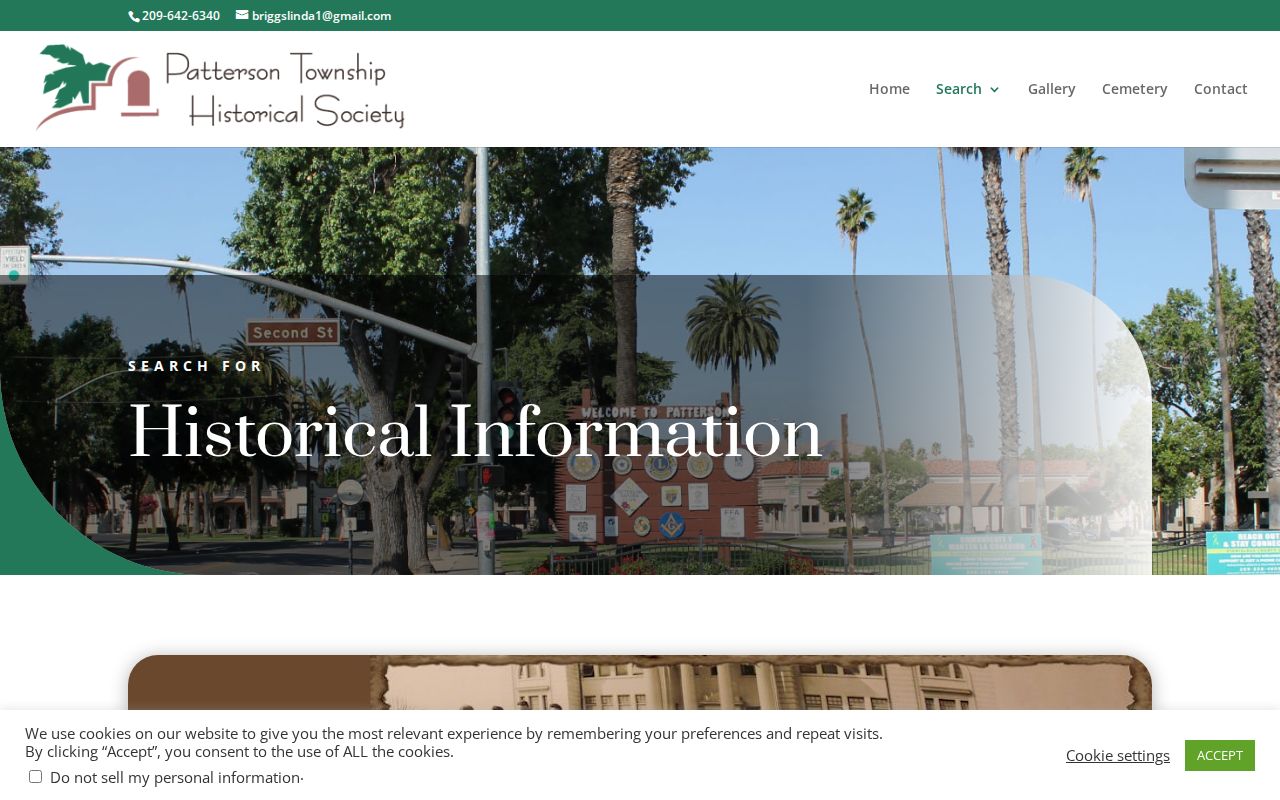
A historical society collection can shed light on an old block question in Patterson. Old photographs, maps, and club records add context to a street's past while keeping the line between public history and private household data intact.
Patterson Requests for Block Records
Some Patterson block records never reach a public index. When that happens, the city's request route is the right tool. The form asks a few simple things. It wants the type of help needed and a contact method. It also asks whether the requester prefers to stay anonymous. Update preferences are on the form too. So are a project or company name, where one applies, and the location or cross street tied to the request.
The city request-routing page works differently than a full CPRA form. Pick a category first. The page then routes the submission to the office that handles it. NextRequest, meanwhile, publishes earlier requests and walks filers through a new one. A block record works best when described by address, APN, project, or date. That framing beats a request for a list of private neighbors.
The anonymity choice deserves care. An anonymous request may sit without priority or follow-up if it is not a public-safety matter. Include contact details whenever a reply matters. To see the route itself, visit the official NextRequest portal.
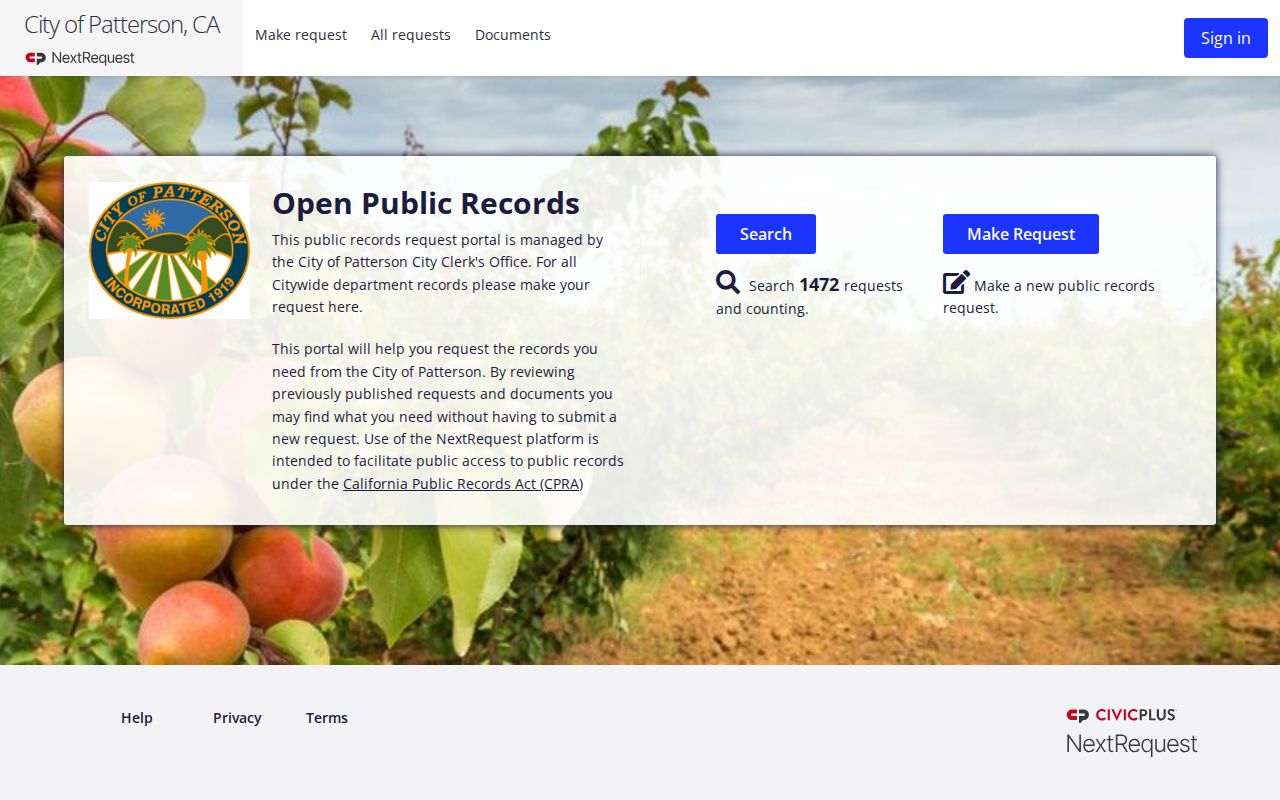
The portal gives Patterson requesters two paths. One is a search across previously published requests. The other is the new-request workflow, which serves as the proper fallback whenever a block record sits outside any public index.
Business Records Add Patterson Context
Business records work differently from a residents directory. They confirm that an entity exists, not that a person lives at a street address. California's bizfile service lets you search entities by name or file number. It returns status, formation dates, jurisdiction, agent, filings, and street or mailing addresses. The city's own business-license list adds a yearly snapshot. It shows business name, mailing city, state, ZIP, and type.
Start with the Secretary of State business search when the question is about an entity. The city list answers what the local license record shows. Keep these separate from county fictitious business names and professional licenses. They are distinct records with their own custodians. A business address never guarantees a household address in Patterson. So treat it as civic context rather than a resident lookup.
The search screen itself is best treated as a civic cross-check. It identifies the custodian and the search mode. It is not a Patterson residents directory or a roster of neighbors on any block.